
Charlotte County Recent Arrest Sources
Start with the Charlotte County Sheriff's Office Local Arrest Database. CCSO hosts this search inside the correctional-facility section of its site. The county page serves as a wrapper. An embedded booking application powers the live lookup. Treat it as a point-in-time jail search, not a full criminal history. A single Charlotte County Jail entry might come from CCSO, Punta Gorda Police, another Florida agency, or a hold lodged elsewhere.
CCSO publishes no 24-hour feed, no 72-hour list, and no weekly arrest log. None is stated. Nor does the office promise a fixed refresh time or roll-off rule. The practical windows here therefore begin with that same official database. Each deeper page defines its own time range. The sheriff guarantees none of them.
| Need | Best starting point | What the window means |
|---|---|---|
| Very recent booking | Arrests Last 24 Hours | A same-day method using current official controls, not a separate CCSO 24-hour feed. |
| Several recent days | Police Blotter | A multi-day research path because CCSO publishes no distinct weekly blotter. |
| One person's custody changes | VINELink Custody Check | Custody and notification data, which may lag a fresh jail intake. |
The official CCSO home page covers more than arrests. It routes visitors to detention records, warrants, VINELink, and agency news, all without republishing a single booking portrait.
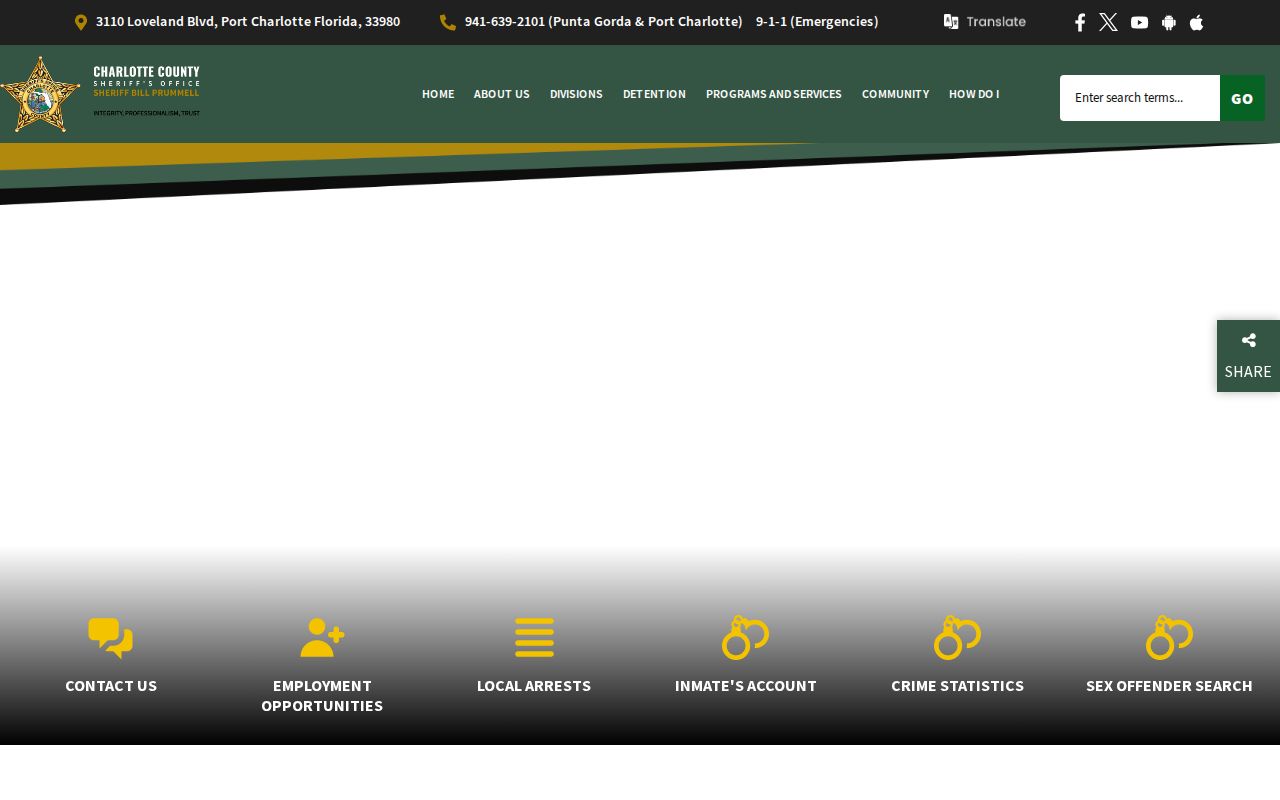
Those navigation links help separate a live booking lookup from records requests, warrants, and news releases.
When Charlotte Arrests Become Searchable
An arrest does not hit the web the moment an officer acts. Transport comes first. Then identification, a search, medical screening, fingerprints, classification, and a photograph. After that, the person is entered into the jail system. Arrest time, arrival time, booking time, and online publication time can each differ. CCSO promises no interval for any of it. So an empty search right after an incident means little.
Punta Gorda adds a wrinkle. That police department transports everyone it arrests to Charlotte County Jail for booking. The arresting agency and the record keeper can differ. Port Charlotte, Englewood, and Rotonda lack separate city police arrest sites. CCSO is therefore the county-level route. Inside the city itself, the Punta Gorda Recent Arrests page explains the municipal records path. It also covers the booking handoff.
For a fresh Charlotte County arrest, search the official database first. Confirm spelling and date of birth. Look for a released-person control in the live interface. Call the jail only with a legitimate custody question. Charlotte County Jail runs around the clock, but continuous website updates are a separate matter.
Note: Record the date and time of a search, since a release, transfer, correction, or court order can change the result. The result you saw earlier may no longer stand.
Search the Charlotte County Jail Roster
The Charlotte County Jail roster anchors local custody searches. The official page opens an embedded application. Indexed descriptions mention name, booking number or date, and a released-inmates option. Not every control is documented. And no booking photo is promised per entry.
| Search field | Best use | Limit |
|---|---|---|
| First and last name | Find a person when the entered spelling is known. | Aliases, punctuation, and common names can cause missed or mixed results. |
| Booking number | Separate similar names and support a later record request. | The number must first be obtained from a record or agency. |
| Booking date | Narrow recent Charlotte County bookings. | The booking date may differ from the arrest date. |
| Released-inmate option | Look beyond people shown in current custody. | The current interface controls and public reach can change. |
A careful roster check uses more than a name:
- Open the official CCSO wrapper and let its live booking interface load.
- Search the full name, then narrow by booking number or date if the controls permit.
- Compare the arresting agency, booking date, charges, and custody or release notation.
- Save the booking number for a precise CCSO record request or Clerk search.
- If no result appears, account for intake lag and any released-person setting before calling the jail.
The embedded CCSO booking application is what visitors actually use. Its live fields say more than any written description of the interface.
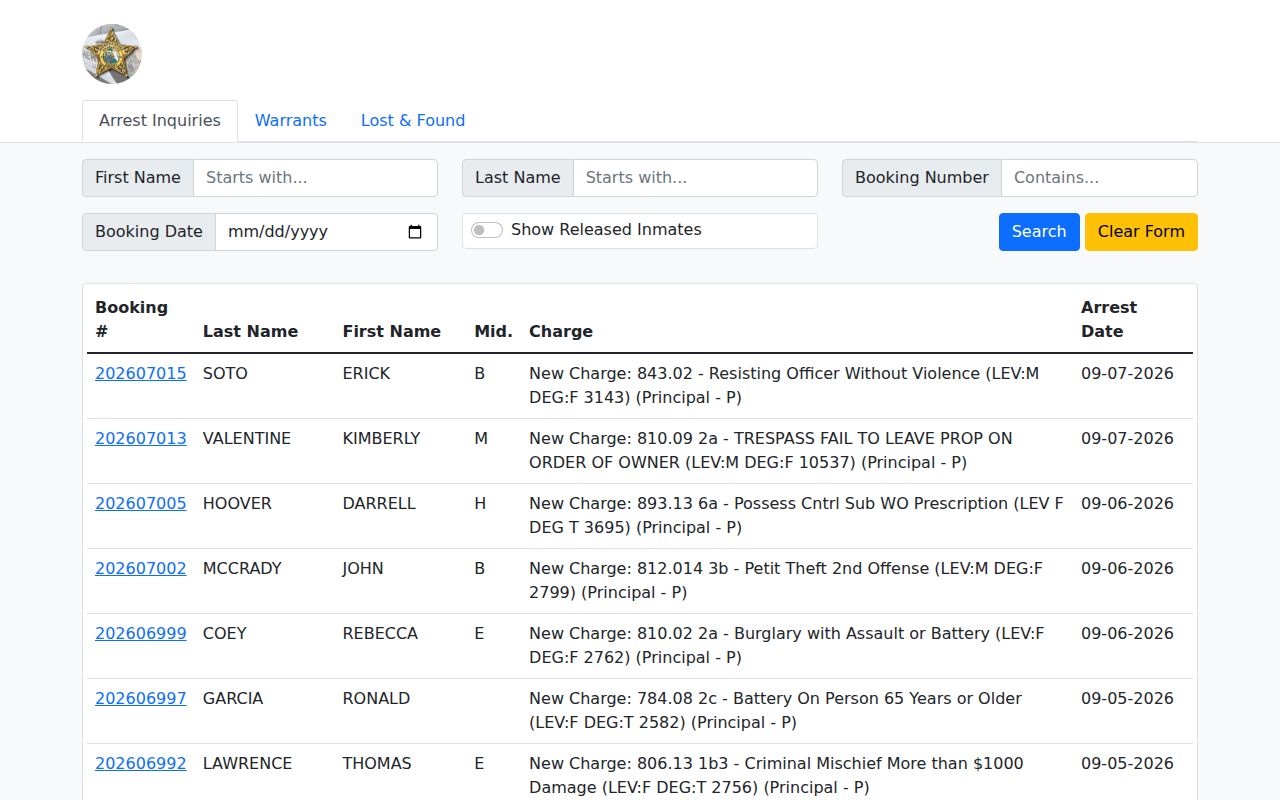
The roster screen is a search tool. It is not a permanent archive or a photo gallery. CCSO announced a mobile app in 2019 featuring recent arrests, alerts, tips, and most-wanted content. Current availability is uncertain. Treat that announcement as history, not a download tip. Official CCSO and PGPD news posts cover selected incidents, but neither channel captures every booking.
Charlotte County Booking Volume
The CCSO Bureau of Detention annual report adds useful context. For 2024, it counted 4,777 adult bookings. Total bookings reached 6,016 in the five-year comparison. Those are admissions, not convictions. The same person can move through the system in ways that make a raw headcount a poor yardstick.
Booking totals and warrant-unit activity answer different questions. A processed warrant is not a jail admission. Neither figure equals a conviction, and mixing them distorts the picture of Charlotte County arrests.
Where Charlotte Arrest Records Appear
Each source covers a different stage of a case. Official channels deserve the first look. They originate or maintain the public record itself. News sites and commercial archives may surface an older mention, yet they can lag, hold stale data, skip corrections, or display fields differently from CCSO.
| Channel | Photo | Status and purpose |
|---|---|---|
| CCSO Local Arrest Database | May appear; no universal text promise | Official county booking and custody starting point. |
| Charlotte Clerk court search | Not the booking-photo source | Official case events, hearings, filings, and disposition. |
| Florida DOC Inmate Search | Identification image may appear | Official state prison or supervision record, not fresh county intake. |
| CCSO or PGPD news | Sometimes | Official but selective incident reporting, not a full roster. |
| Local newspaper or television | Sometimes | Episodic journalism that may add context, never a complete feed. |
| Commercial county archives | Often | Unofficial discovery tools that can be stale or incomplete; verify every item. |
Plenty of commercial sites republish Charlotte County arrest data. Busted Newspaper, RecentlyBooked, Florida Arrests, Mugshots.zone, Mugshots.com, and JailMugshots.org all sit in that tier. None are linked here. Official sources must lead. Commercial copies should never pass for county data, and their pages can linger long after release or after the official roster changes. For reporting, the Charlotte Sun, Gulf Coast News, the CCSO Blog, and PGPD News cover selected arrest stories rather than daily jail intake. Question: Does an archived photo prove present custody? It proves only that the publisher displayed an image, so confirm custody with CCSO and the outcome with the Clerk.
What Charlotte Arrest Records Show
A booking record documents intake into custody. Florida's correctional records schedule describes a fuller packet than any public screen shows. That packet can include the intake form, commitment material, booking card, criminal report affidavit, court orders, and release paperwork. Public access can be narrower, since confidential or exempt content must be redacted.
| Field | What it explains |
|---|---|
| Name and booking number | The entered identity and the jail identifier used to distinguish similar names. |
| Booking date and time | When intake was recorded, which may not equal arrest or publication time. |
| Arresting agency | Whether CCSO, PGPD, another agency, or a hold initiated the booking. |
| Charges as booked | The intake charges, not a judgment or final court result. |
| Bond or release condition | The amount, no-bond notation, recognizance release, or hold when published. |
| Court information | A first appearance or court destination, not the full continuing docket. |
| Photo and descriptors | Identification details when lawfully released and shown. |
| Custody or release | The jail status at that point, which can change after bond, court, or transfer. |
- Booking
- The intake process that creates the jail entry.
- Bond
- A court-set condition that may permit release while the case continues.
- Arraignment
- A court stage where charges and a plea are addressed.
- Disposition
- The recorded outcome of a charge or case.
- Detainer
- A request or hold from another authority that may affect release.
- Expungement
- A court-ordered remedy that removes qualifying records from ordinary public access under Florida law.
Request a Charlotte Arrest Record
When the roster lacks an entry, a photo, or older booking detail, start at the CCSO public-records page. It is the right first stop. CCSO accepts requests several ways. An online form runs through JustFOIA. Email goes to publicrecords@ccsofl.net, and written requests go to the records custodian. Name a specific item. Ask for the booking card, booking photograph, arrest affidavit, or release record. Include the person's name, booking number, date, and the file format you want.
- Verify the available booking number and date in the CCSO database.
- Open the agency's JustFOIA public request portal or use its published email or mail route.
- Describe the exact record and identify whether an electronic copy will meet the need.
- Ask for an estimate before work begins if research, review, duplication, or redaction may create a charge.
- Keep the submission date, tracking number, response, fee estimate, and any exemption cited.
CCSO publishes no fixed fee for every booking photo and no guaranteed turnaround. Florida law requires a prompt, good-faith response. Complexity, active-investigation review, redaction, volume, and format can each affect timing. PGPD sets its own policy and fee schedule. Its $6.25 charge is not a CCSO fee. That charge covers each additional 15 minutes after the first 30. The official request screen is where a precise CCSO records submission begins. That portal starts the clock.
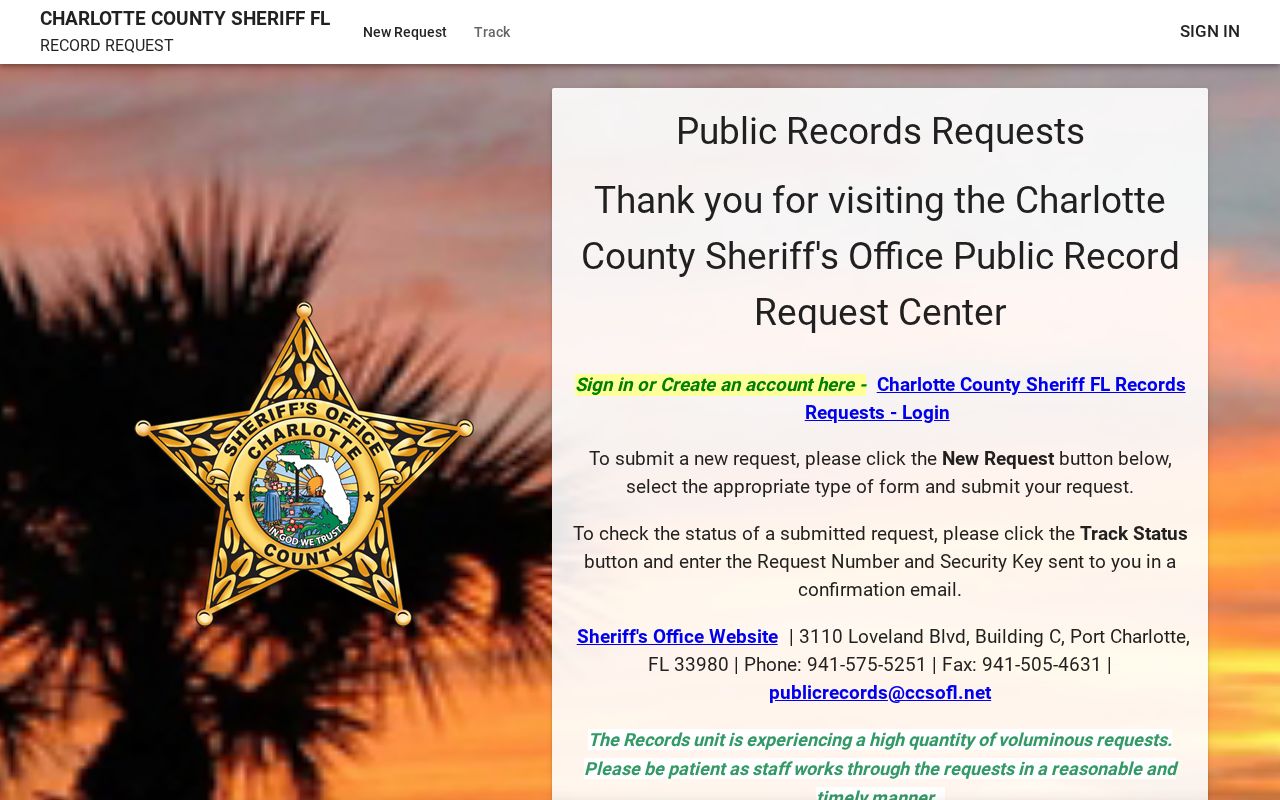
A specific request beats a broad one. Narrow asks are easier for the office to route, review, and answer than a demand for every record about a person.
Charlotte County Mugshots and Arrest Photos
A booking photograph is an identification image taken during intake. The CCSO wrapper confirms a public booking database. It never promises a photo for every entry, nor says how long one stays online. A live result without a photo? Request that specific booking photograph from CCSO Records. A missing public image does not prove no image was taken. The Florida Department of Corrections may display an identification photograph for someone in state custody or supervision. That is an FDC image tied to a state profile, not necessarily the Charlotte County booking photo. Newspapers and commercial archives may also reproduce agency-supplied images. Their continued display says nothing about present custody. No booking photographs are reproduced on this page. The choice keeps source context with the office that can correct or explain the record. It also avoids building a gallery of accused people.
Florida Law on Arrest Records
Under Florida Statutes Chapter 119, state, county, and municipal records stay open to the public at reasonable times and under reasonable conditions. Specific exemptions exist. CCSO says confidential or exempt information will be redacted. Juvenile material, protected victim data, sealed or expunged matters, medical details, and active investigative information may all receive different treatment.
Florida's GS2 schedule keeps booking records and commitment-and-release lists for at least one anniversary year after release. That is only a retention floor. It is not a promise that the CCSO web interface will expose a full year of bookings. A live roster, a retained agency file, a Clerk docket, and an archive are four different things. Know which one you need.
CCSO now runs administrative and records operations from 3110 Loveland Boulevard, Building C, Port Charlotte, FL 33980. The move came in 2026. Public operations left the former Utilities Road office. Guides still citing Utilities Road are outdated.
Note: Juvenile and sealed-record rules run separately, and absence from a public search proves nothing about any person's history.
Correcting Charlotte Arrest Information
Fix errors at the source. When a CCSO booking record lists the wrong person, misspells a name, duplicates an entry, leaks protected data, or clashes with a court order, write to CCSO Records. Include the booking number, the date, the disputed field, and proof. A changed charge or finished case calls for a certified disposition from the Charlotte Clerk. Keep one thing straight. An arrest record that was true when published stays accurate. That holds even after a later dismissal.
For Florida sealing or expungement, the FDLE seal-and-expunge process starts with a Certificate of Eligibility. It then moves ahead through court-ordered relief. FDLE sets a nonrefundable $75 certificate fee. It allows qualifying relief only once per lifetime. Whether a person qualifies turns on the charge, the disposition, any earlier relief, and statutory exclusions. No single waiting period fits every arrest.
Florida Statutes section 901.43 creates a free written path for a covered person, or a legal representative. That path lets them demand that a business take down a published booking photograph. Send a compliant request by registered mail to the publisher's registered agent. Include proof of identity and enough detail to pinpoint the photo. The law allows ten calendar days for removal in covered cases and forbids charging a fee. Its scope and exceptions control in the end.
Commercial sites sometimes promote free correction or removal channels. Those are private policies that can shift anytime. Save the page URL. Follow the publisher's current free process, and attach any sealing order, dismissal, acquittal, or identity proof that helps. Refuse any intermediary demanding payment for what the law makes free. Search engines offer their own stale-content tools, yet those tools never touch the underlying record at its source.
Charlotte Arrest Warrants and Wanted Tips
A warrant question in Charlotte County calls for two separate checks. Start with the sheriff. CCSO keeps a warrants area plus a warrant inquiry route, and its Warrants unit answers 941-833-6363 and jailwarrants@ccsofl.net. The Charlotte Clerk case search helps too. It can surface a capias or a failure-to-appear entry tied to a case. Only the sheriff confirms an active warrant. Web results lag, and listings run incomplete.
CCSO lists no stable "Most Wanted" page with a fixed countywide total. Southwest Florida Crime Stoppers fills that gap with a shifting regional wanted list that includes Charlotte County entries. The nonprofit runs a tip line, not a warrant database. Its regional wanted page shows how those entries look. Treat it as a tip tool, nothing more.
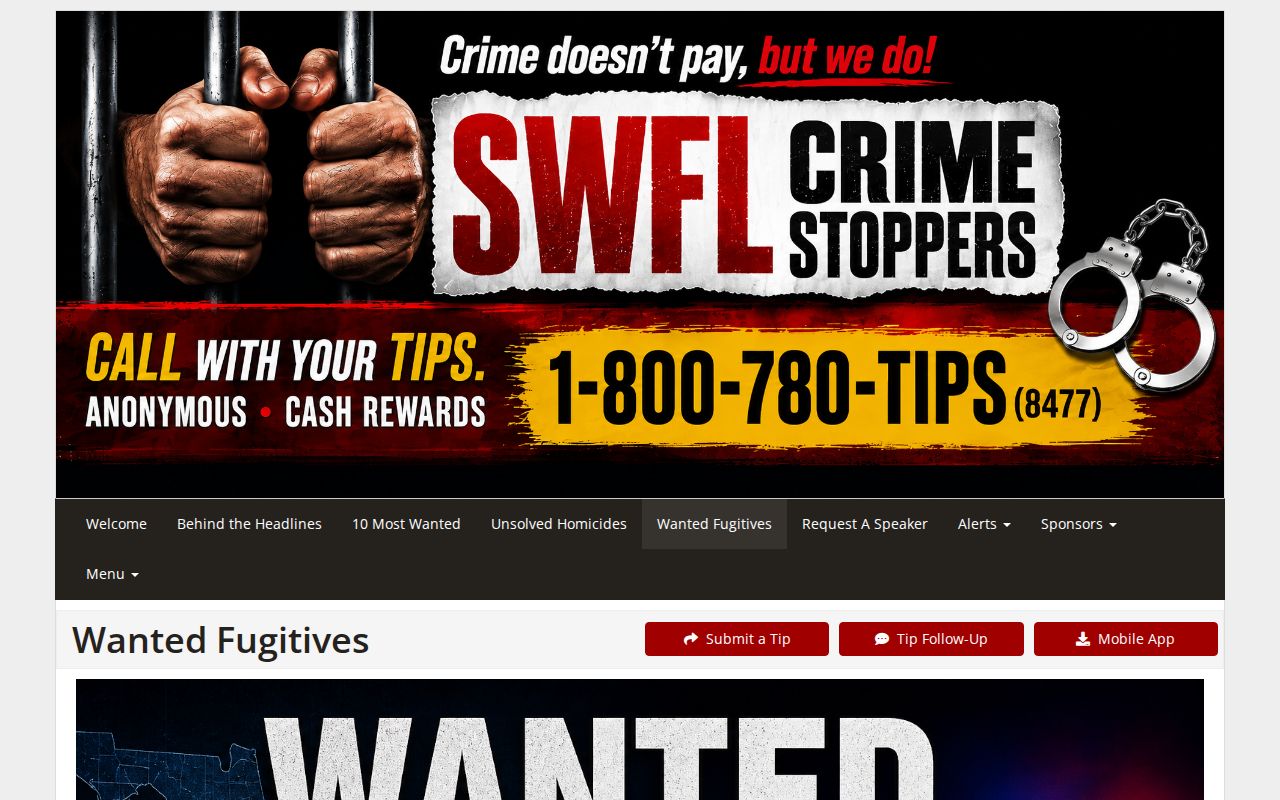
The regional list changes page by page. Entries come and go without warning. It can never substitute for a direct warrant inquiry with the sheriff. Never approach, follow, or contact a wanted person. For immediate danger, call 911; for a tip, use Crime Stoppers. Anyone who thinks a warrant carries their name should speak with an attorney or the court and resolve it lawfully.
After a Charlotte County Arrest
Booking is only the start in Charlotte County. The court case then moves on its own track. Florida rules call for a first appearance within 24 hours. The CCSO victim-rights guide puts the local schedule at 24 to 48 hours. That schedule applies at the Justice Center. The actual docket controls. Bond can change. Charges, plea events, and trial activity can all shift after that first public booking record.
For the ongoing case, use the Charlotte Clerk court search. Match the court case number against the booking information. The clerk's record holds the outcome a jail page never will. There you learn if a charge was dropped, plea-resolved, or decided at trial. The official court-search page carries the case once the jail record exists.
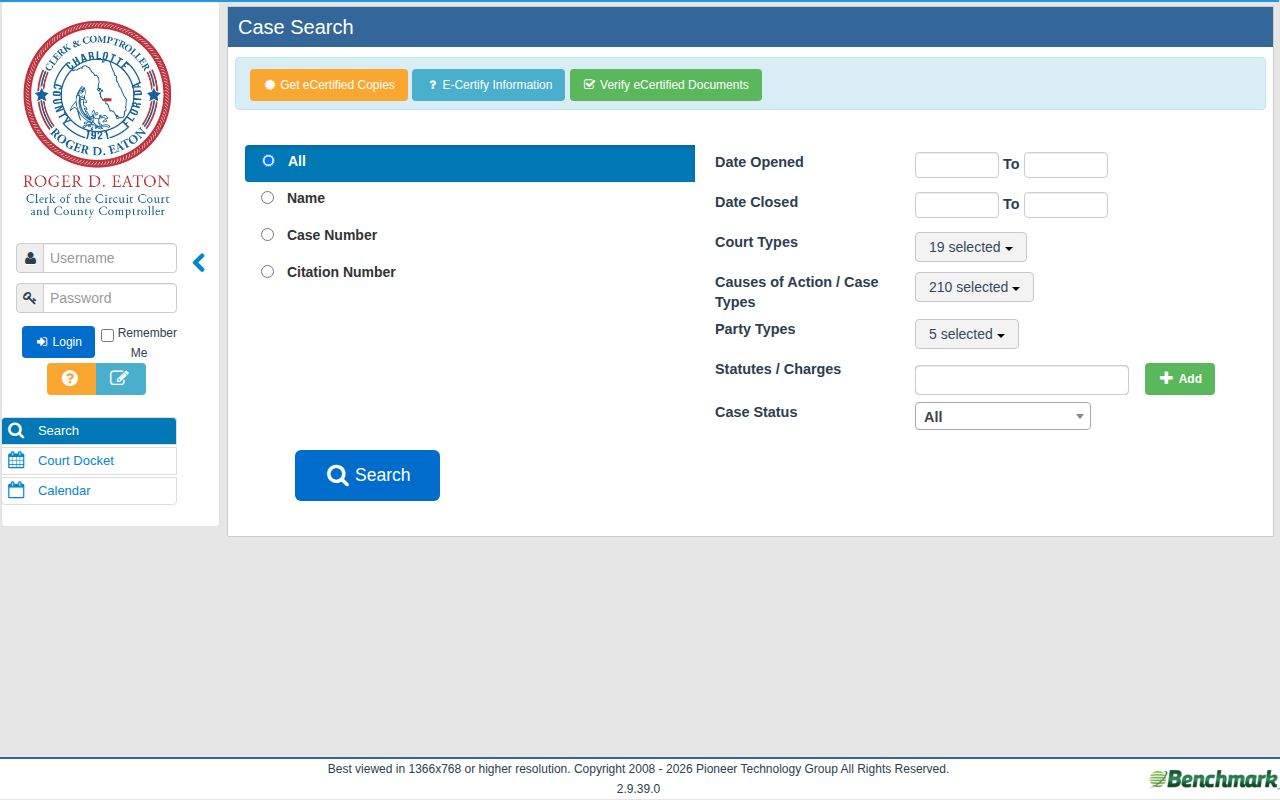
Question: Why can the charge names differ? A jail booking page lists whatever charge appeared at the time of the arrest. The Clerk record, though, tracks the case through court, where prosecutors and judges may amend, combine, reduce, or drop counts.
Charlotte Jail and State Prison
History and present custody are two different things in Charlotte County. The old jail era shows up in CCSO records. A former jailer is on file. A 1963 escape is too. Today's county detention happens at the Charlotte County Jail on Airport Road. Charlotte Correctional Institution sits in Punta Gorda too. It answers to the Florida Department of Corrections. So an old jail fact tells you nothing about who is in custody now. And a state prison address tells you nothing about a fresh Charlotte County arrest.
Charlotte Records After Release or Transfer
Where a person sits in the system decides where you look. Just processed? The county intake system comes first. Once Charlotte County Jail holds someone, the CCSO roster is the place to check. Release changes things again. A released person may only appear through the released-person control or a formal records request. Sentences to Florida prison move the record into the Florida Department of Corrections system entirely. Supervision by the state does too.
| Status | Source | What it can confirm |
|---|---|---|
| Just arrested | Arresting agency and CCSO database | Incident information and a booking entry after intake lag. |
| In county custody | CCSO roster or jail | Current county booking and custody details. |
| Released | CCSO records and Charlotte Clerk | Retained booking material plus the continuing court case. |
| State prison or supervision | Florida DOC Inmate Search | FDC profile, status, location, and image when available. |
| Federal sentence | Federal Bureau of Prisons locator | Federal custody, generally without a public profile photo. |
| Immigration custody | ICE detainee locator | Separate federal immigration custody, not county booking history. |
After a person leaves the county jail, look further up the chain. The Florida Department of Corrections Inmate Search tracks offenders inside state prison. Charlotte Correctional Institution sits in Punta Gorda. That FDC prison is not the county jail, though. Its inmates are not fresh Charlotte County arrests. Federal cases run through separate BOP and ICE systems.
Charlotte County Arrests by City
Punta Gorda stands alone as the county's one incorporated city. Its police department handles arrests inside city limits. After an arrest, officers bring people to Charlotte County Jail for booking. The department's city page offers no standing arrest roster. Recent arrests surface mainly through selective news releases. A records portal rounds things out for municipal incident and arrest paperwork.
- Punta Gorda Recent Arrests: PGPD records, city news, the CCSO booking handoff, and official county custody checks.
Port Charlotte, Englewood, and Rotonda are unincorporated communities, not true Charlotte County cities. They get no separate city arrest pages here. That choice keeps the city map honest about jurisdiction. Residents in those areas can rely on the CCSO roster, CCSO Records, and the Charlotte Clerk for arrest and booking information.
Charlotte County Sheriff’s Office Location and Directions
Charlotte County Sheriff’s Office
3110 Loveland Boulevard, Building CPort Charlotte, FL 33980
941-639-2101
Public Record Search
Sponsored Results